Inquiry Basket
| Your inquiry basket is currently empty. |
G protein-coupled receptors (GPCRs) are integral membrane proteins that play essential roles in cellular signaling and communication. Among the GPCRs, class A receptors are the largest and most extensively studied subgroup, with significant implications in various physiological processes, including neurotransmission, hormone regulation, and immune responses. In recent decades, structural research on class A GPCRs has significantly advanced, shedding light on their activation mechanisms and providing insights into the development of novel therapeutics.
Class A GPCRs are characterized by their seven-transmembrane helices and their activation through G protein coupling. These receptors are of great interest to researchers due to their involvement in a wide range of physiological functions and their potential as drug targets. Early research on GPCRs mainly relied on X-ray crystallography, which led to landmark discoveries, such as the first high-resolution structure of a GPCR, rhodopsin, in 2000.
Over the past two decades, the advent of cryo-electron microscopy (cryo-EM) has revolutionized structural biology, allowing the visualization of GPCRs at near-atomic resolution. The latest cryo-EM structures of GPR119 (a cannabinoid receptor-like class A GPCR) and its interactions with agonists provide significant revelations regarding its activation and signaling mechanisms, thereby contributing to the advancement of innovative therapeutic strategies.
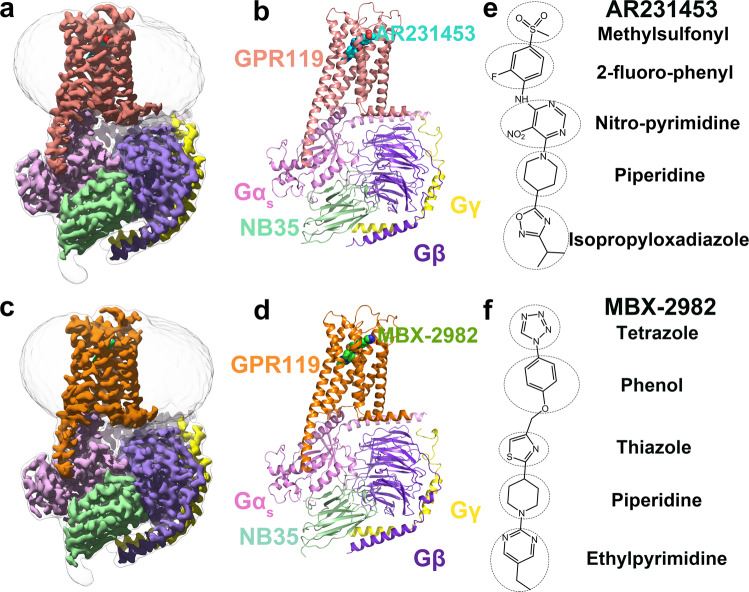 Figure 1. Overall cryo-EM structures of the GPR119-Gs heterotrimer complexes. (Qian Y, et al., 2022)
| Protein | Organism | Method | Resolution | PDB Entry ID |
| Rhodopsin in ligand-free state (opsin) | Bos taurus | X-ray diffraction | 2.65 Å | 4J4Q |
| Rhodopsin in ligand-free state (opsin) | Bos taurus | X-ray diffraction | 2.29 Å | 4X1H |
| Rhodopsin in ligand-free state (opsin) in complex with ArrFL-1 | Bos taurus | X-ray diffraction | 2.75 Å | 4PXF |
| Rhodopsin, N2C/D282C stabilized opsin bound to RS01 (expressed in HEK293S cells) | Bos taurus | X-ray diffraction | 2.36 Å | 6FK6 |
| Rhodopsin-Gαi-βγ complex (expressed in HEK293 cells) | Bos taurus | Cryo-EM single particle analysis | 4.38 Å | 6QNO |
| Rhodopsin-Transducin Complex (expressed in Escherichia coli) | Bos taurus | Cryo-EM single particle analysis | 3.90 Å | 6OY9 |
| Visual Signaling Complex between Transducin and Phosphodiesterase 6 (expressed in Escherichia coli) | Bos taurus | Cryo-EM single particle analysis | 3.20 Å | 7JSN |
| Rhodopsin (native dimer) in nanodiscs | Bos taurus | Cryo-EM single particle analysis | 4.50 Å | 6OFJ |
| Rhodopsin in complex with rhodopsin kinase (GRK1) (expressed in Spodoptera frugiperda) | Bos taurus | Cryo-EM single particle analysis | 7.00 Å | 7MT9 |
| Bovine rhodopsin in Lipidic Cubic Phase (SACLA) | Bos taurus | X-ray diffraction | 1.80 Å | 7ZBC |
| Human rhodopsin with bound mouse visual arrestin (expressed in HEK293S cells) | Homo sapiens | X-ray diffraction | 3.30 Å | 4ZWJ |
| Human rhodopsin with bound inhibitory G protein (Gi) (expressed in Sf9 cells) | Homo sapiens | Cryo-EM single particle analysis | 4.50 Å | 6CMO |
| Jumping Spider Rhodopsin-1 bound to 9-cis retinal (expressed in HEK293 cells) | Hasarius adansoni | X-ray diffraction | 2.15 Å | 6I9K |
| GPR17-Gi complex (expressed in Spodoptera frugiperda) | Homo sapiens | Cryo-EM single particle analysis | 3.02 Å | 7Y89 |
| Gi bound orphan GPR20 in ligand-free state (expressed in Spodoptera frugiperda) | Homo sapiens | Cryo-EM single particle analysis | 3.14 Å | 8HS3 |
| GPR21-Gs complex (expressed in Spodoptera frugiperda) | Homo sapiens | Cryo-EM single particle analysis | 2.91 Å | 8HMV |
| GPR52 ligand free form with flavodoxin fusion (expressed in Spodoptera frugiperda) | Homo sapiens | X-ray diffraction | 2.90 Å | 6LI1 |
| Orphan GPR88 class A receptor - Gi1 complex, apo form (expressed in Spodoptera frugiperda) | Homo sapiens | Cryo-EM single particle analysis | 3.00 Å | 7WZ4 |
| GPR119-Gs-LPC complex (expressed in Trichoplusia ni) | Homo sapiens | Cryo-EM single particle analysis | 3.10 Å | 7XZ5 |
| GPR119-Gs Complex with small molecule agonist AR231453 (expressed in Trichoplusia ni) | Homo sapiens | Cryo-EM single particle analysis | 2.87 Å | 7WCN |
| Orphan GPCR in complex with Gi (expressed in Spodoptera frugiperda) | Homo sapiens | Cryo-EM single particle analysis | 3.20 Å | 7VUG |
| LPS-bound GPR174 in complex with Gs protein (expressed in Spodoptera frugiperda) | Homo sapiens | Cryo-EM single particle analysis | 2.76 Å | 7XV3 |
| GSK682753A-bound EBI2/GPR183 (expressed in Spodoptera frugiperda) | Homo sapiens | Cryo-EM single particle analysis | 2.98 Å | 7TUY |
| OX1 orexin receptor with bound suvorexant (expressed in Spodoptera frugiperda) | Homo sapiens | X-ray diffraction | 2.75 Å | 4ZJ8 |
| Orexin-1 receptor in complex with suvorexant (expressed in Spodoptera frugiperda) | Homo sapiens | X-ray diffraction | 2.26 Å | 6TO7 |
| OX1 orexin receptor with bound subtype-selective antagonist (expressed in Spodoptera frugiperda) | Homo sapiens | X-ray diffraction | 3.50 Å | 6V9S |
| OX2 orexin receptor with bound suvorexant (expressed in Spodoptera frugiperda) | Homo sapiens | X-ray diffraction | 2.50 Å | 4S0V |
| OX2 orexin receptor in complex with suvorexant (expressed in Spodoptera frugiperda) | Homo sapiens | X-ray diffraction | 2.74 Å | 6TPJ |
| OX2 orexin receptor with bound antagonist EMPA (expressed in Sf9 cells) | Homo sapiens | X-ray diffraction | 1.96 Å | 5WQC |
| OX2 orexin receptor in complex with G protein and natural peptide-agonist Orexin B (OxB) (expressed in Trichoplusia ni) | Homo sapiens | Cryo-EM single particle analysis | 3.20 Å | 7L1U |
| OX2 orexin receptor in complex with Gi protein and TAK-925 (expressed in Spodoptera frugiperda) | Homo sapiens | Cryo-EM single particle analysis | 3.17 Å | 7SQO |
| OX2 orexin receptor with bound lemborexant (expressed in Spodoptera frugiperda) | Homo sapiens | X-ray diffraction | 2.89 Å | 7XRR |
| C5a anaphylatoxin chemotactic receptor 1 (C5aR) in complex with NDT9513727 (expressed in Spodoptera frugiperda) | Homo sapiens | X-ray diffraction | 2.70 Å | 5O9H |
| C5a anaphylatoxin chemotactic receptor 1 (C5aR) in complex with orthosteric antagonist PMX53 and allosteric antagonist NDT9513727 (expressed in Spodoptera frugiperda) | Homo sapiens | X-ray diffraction | 2.90 Å | 6C1Q |
| α1B-adrenergic receptor in complex with inverse agonist (+)-cyclazosin (expressed in Escherichia coli) | Homo sapiens | X-ray diffraction | 2.87 Å | 7B6W |
| alpha2A adrenergic receptor in complex with an antagonist RSC (expressed in Spodoptera frugiperda) | Homo sapiens | X-ray diffraction | 2.70 Å | 6KUX |
| alpha2A adrenergic receptor GoA signaling complex bound to a G protein biased agonist (expressed in Spodoptera frugiperda) | Homo sapiens | Cryo-EM single particle analysis | 3.47 Å | 7W6P |
| alpha2BAR-GoA complex (expressed in Sf9 cells) | Homo sapiens | Cryo-EM single particle analysis | 2.90 Å | 6K41 |
| alpha2C adrenergic G protein-coupled receptor (expressed in Spodoptera frugiperda) | Homo sapiens | X-ray diffraction | 2.80 Å | 6KUW |
Table 1. Structural research of class-A GPCRs.
Creative Biostructure offers comprehensive structural analysis services for class A GPCRs, tailored to meet the specific needs of researchers and pharmaceutical companies. Our multidisciplinary approach combines cryo-electron microscopy (cryo-EM), X-ray crystallography, and computational modeling to provide a holistic understanding of GPCR structures and their interactions with ligands and G proteins.
Researchers and pharmaceutical companies seeking to gain a deeper understanding of GPCRs and harness this knowledge to develop novel therapies are encouraged to collaborate with Creative Biostructure. Our state-of-the-art facilities, experienced team, and track record of successful structural studies make us a reliable partner in advancing the field of GPCR research. Contact us to discover how our cutting-edge capabilities can empower your research and drive you closer to achieving your scientific goals.
References
Easy access to products and services you need from.











For Research or Industrial Raw Materials, Not for Personal Use!