Cosmetic-Grade Plant Derived Exosome Development
Consumers are demanding sustainable, vegan, and high-performance ingredients. While traditional plant extracts are common, they often lack deep skin penetration. Plant-Derived Exosomes (PDEs)—also known as Plant-Derived Nanovesicles (PDNVs)—represent the next evolution of botanical skincare.
We provide specialized Plant Derived Exosome Development solutions. From Ginseng for anti-aging to Rose for hydration and Citrus for brightening, we help you isolate, characterize, and formulate high-purity botanical exosomes. Our platform enables you to launch "Clean Beauty" products that deliver the scientific efficacy of medical skincare without the regulatory hurdles of human-derived ingredients.
Why Plant Exosomes for Modern Skincare?
Plant exosomes combine the marketing appeal of "natural ingredients" with the efficacy of "delivery systems."
- Superior Penetration: Unlike crude plant extracts, exosomes are lipid-encapsulated nanocarriers. They protect fragile antioxidants (like polyphenols and vitamins) and facilitate deep delivery into the dermis.
- Potent Antioxidant & Whitening: Many PDEs naturally carry high levels of antioxidants and tyrosinase inhibitors, making them powerful agents for skin brightening and fighting oxidative stress.
- Vegan & Sustainable: Sourced from renewable plant materials (leaves, fruits, roots), PDEs meet the strict criteria for Vegan and Cruelty-Free certifications, appealing to eco-conscious consumers.
- Anti-Inflammatory: Plant exosomes (e.g., from Centella Asiatica/Cica) have innate immune-modulating properties, ideal for soothing sensitive or acne-prone skin.
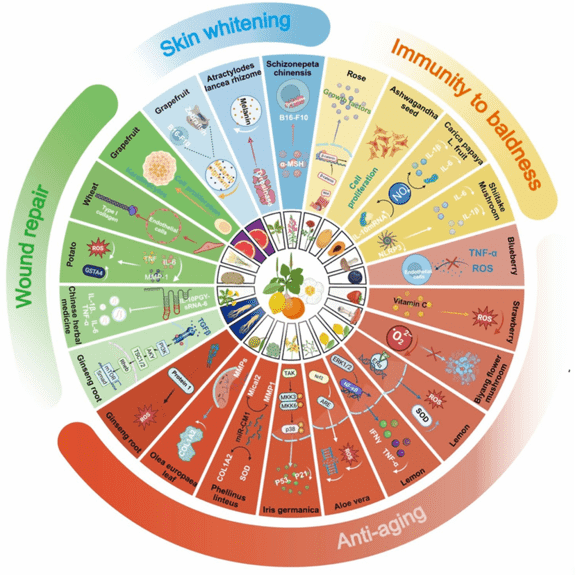 Figure 1. Biological functions of PENs (Plant-Derived Exosomes) in skin therapy, including anti-aging, anti-degeneration, skin whitening, and wound healing. (Liu H, et al., 2025)
Our Botanical Development Workflow
Extracting vesicles from tough plant cell walls requires different expertise than mammalian cell culture. We offer a specialized "Leaf-to-Label" pipeline.
| Development Phase | Our Specialized Approach & Solution | Key Services Applied |
|---|---|---|
| Botanical Sourcing & Prep | Raw Material Optimization: We work with fresh, organic plant sources. We utilize specialized juicing and homogenization protocols to disrupt plant cell walls without destroying the nanovesicles inside. | Plant-Derived Exosome Isolation |
| Plant-Specific Isolation | Removing Pigments & Fibers: Plant juices are complex. We use differential centrifugation combined with Tangential Flow Filtration (TFF) to separate exosomes from chlorophyll, starch, and fibrous debris, yielding a clear, cosmetic-grade active. | Exosome Isolation by Tangential Flow Filtration (TFF) |
| Bio-Characterization | Ingredient Validation: We characterize the particle size (NTA) and verify the presence of plant-specific lipids. We quantify the payload, such as measuring total polyphenol content or specific vitamins within the vesicles. | Exosome Characterization by NanoFCM |
| Efficacy & Claims | Functional Testing: We validate marketing claims using relevant assays: Tyrosinase Inhibition (Whitening), DPPH Assay (Antioxidant), or Collagenase Inhibition (Anti-aging). | In Vitro Exosome Functional Assays |
Core Technologies for "Green" Ingredients
Extracting nanovesicles from plant matrices requires specialized technology to overcome cell walls and complex impurities. We utilize a proprietary "Green Chemistry" workflow to ensure purity and potency.
Gentle Cell Wall Disruption & Extraction
Overcoming the Cellulose Barrier: Unlike animal cells, plant cells are encased in rigid walls. Standard grinding destroys vesicles. We utilize a proprietary enzymatic digestion combined with low-shear microfluidization. This method gently digests pectin and cellulose to release the nanovesicles intact, ensuring high yields without damaging the delicate lipid membrane or oxidizing the active cargo.
TFF-Based Pigment & Sugar Removal
Cosmetic-Grade Clarity: Crude plant extracts are often dark, sticky, and rich in sugars/polyphenols that destabilize formulations. We employ a multi-stage Tangential Flow Filtration (TFF) and Size Exclusion Chromatography (SEC) process. This "molecular washing" effectively removes chlorophyll (pigments), starch, and sticky lignins, yielding a clear, non-staining, and highly pure nanovesicle concentrate suitable for high-end serums.
Phytochemical Cargo Profiling
Proof of Potency: How do you know the vesicles carry the plant's active benefits? We go beyond particle counting. We utilize High-Performance Liquid Chromatography (HPLC) and Lipidomics to profile the cargo. We verify that key actives (e.g., Ginsenosides in Ginseng, EGCG in Green Tea) are encapsulated within the exosomes, providing you with a "Bioactive Fingerprint" certificate to support your marketing claims.
Nano-Stability Formulation
Preserving Freshness: Plant-derived vesicles can be sensitive to pH and oxidation. We develop custom nano-emulsion or liposome-hybrid formulations that stabilize the plant exosomes. This ensures that they remain stable (no aggregation or color change) in your final product formulation, maintaining their antioxidant power from the lab to the consumer's shelf.
Application Spotlight: Ginseng Exosomes for Anti-Aging
This analysis highlights how exosomes from a traditional medicinal plant can outperform standard extracts in high-value skincare applications.
Featured Technologies:
- Plant Exosome Isolation
- Efficacy Assays (Anti-Senescence)
Literature Interpretation:
Panax ginseng is a legendary anti-aging herb, but its cellular delivery has been limited. Researchers isolated exosome-like nanoparticles (ELNs) from Ginseng roots and tested their effects on human dermal fibroblasts. The study found that these Ginseng exosomes were readily internalized by skin cells and significantly suppressed the expression of senescence-associated markers (such as SA-β-gal, p16, and p21). Crucially, the exosomes restored the proliferation capacity of replicative senescent cells more effectively than free Ginseng extracts. This data confirms that plant-derived nanovesicles possess intrinsic anti-aging bioactivity and superior cellular uptake properties compared to bulk extracts, establishing them as functional ingredients for next-generation skincare formulations.
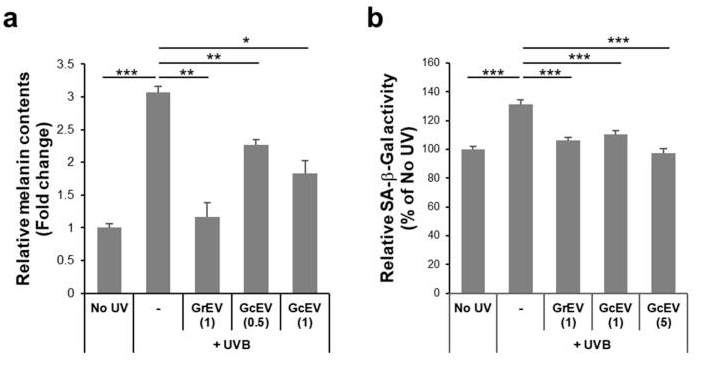 Figure 2. Effects of Ginseng cell-derived extracellular vesicles (GcEVs) on melanocytes with UVB-induced senescence. (a) Melanin content and (b) senescence-associated beta-galactosidase (SA β-Gal) activity measured after treatment with GcEVs. (Cho EG, et al., 2021)
Start Your Clean Beauty Project
Turn nature's secrets into your brand's next bestseller with a scientifically validated development plan.
How It Works: Our Project Pathway
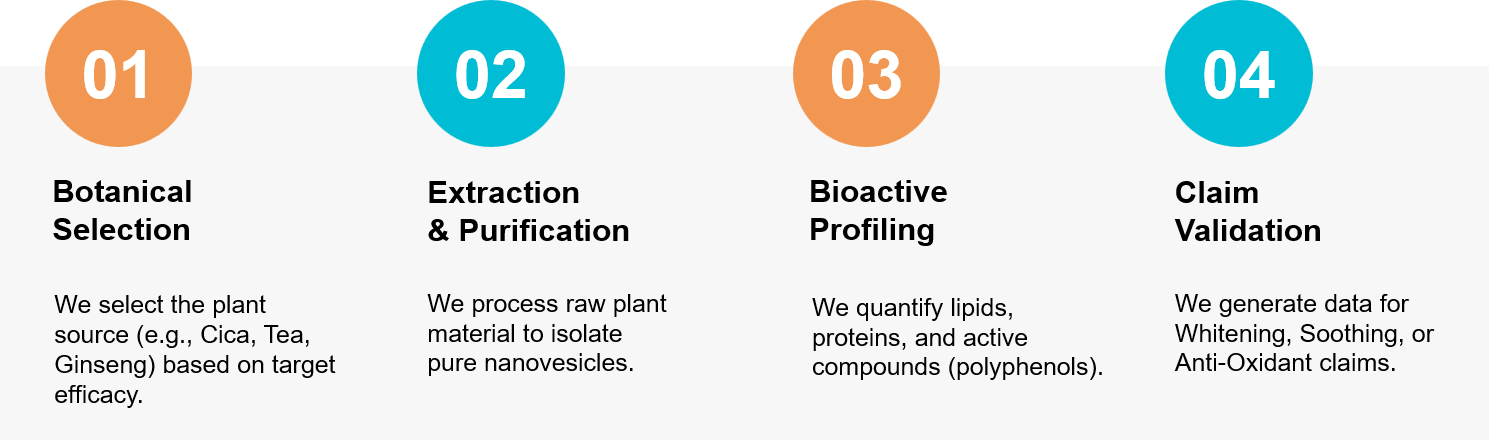 Figure 3. Our green chemistry workflow for isolating bioactive nanovesicles from botanical sources for vegan skincare applications. (Creative Biostructure)
Ready to define the future of clean beauty with scientifically proven botanical actives? Our scientific team is available for a free consultation to discuss your plant exosome strategy. Contact us today to discuss your project.
References
- Liu H, Dong T, Dong C, et al. Plant-derived exosome-like nanovesicles: a novel therapeutic perspective for skin diseases. J Nanobiotechnology. 2025 Oct 10;23(1):640.
- Cho EG, Choi SY, Kim H, et al. Panax ginseng-Derived Extracellular Vesicles Facilitate Anti-Senescence Effects in Human Skin Cells: An Eco-Friendly and Sustainable Way to Use Ginseng Substances. Cells. 2021 Feb 24;10(3):486.